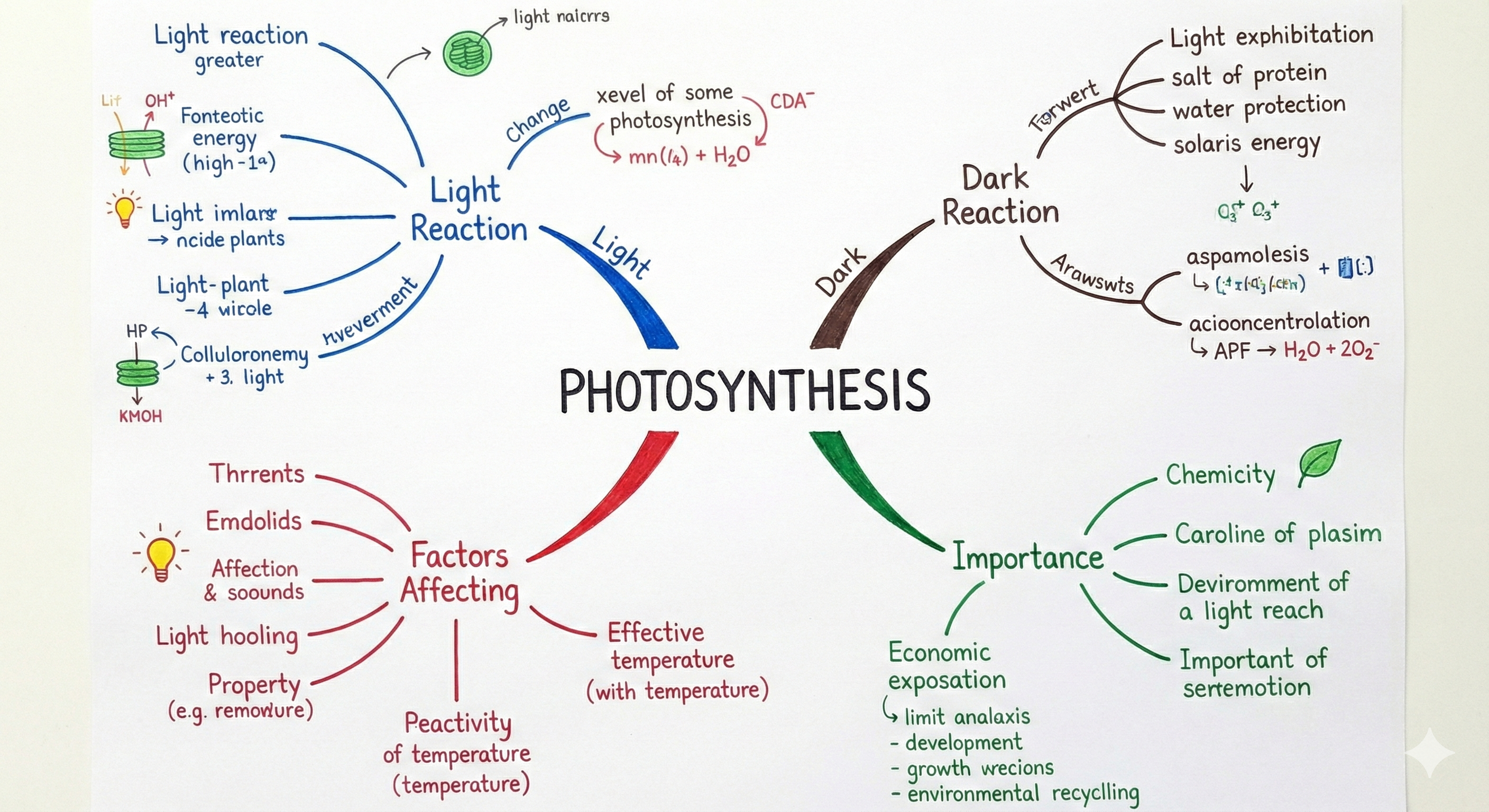
Imagine if you were allowed to bring one sheet of paper into the exam hall. What would you put on it?
You probably wouldn't write full sentences. You’d write formulas, keywords, and connections. This mental exercise is actually one of the most powerful ways to study, even if you can't take the paper into the exam.
Why Summarization Works To shrink a 20-page chapter into a one-page summary, your brain has to perform high-level processing. You have to decide what is essential and what is "fluff." This decision-making process locks the information into your long-term memory.
How to Create the Ultimate One-Pager:
The Title Center: Write the main topic in the center of the page.
Branch Out (Mind Mapping): Draw branches for the main sub-topics. For example, if the topic is "Photosynthesis," branches might be "Light Reaction," "Dark Reaction," and "Factors Affecting it."
Use Keywords Only: Banish full sentences. Use "-> " symbols to show cause and effect.
Color Code: Use Red for definitions, Blue for formulas, and Green for examples.
The "Cornell" Tweak: Leave a 2-inch margin on the left side. After you finish your sheet, write down questions in that margin that your summary answers.
The Result By the time you finish designing this "cheatsheet," you will often find you don’t even need to look at it anymore. You’ve already learned it.
Struggling to condense your notes? Our expert tutors at Edukom can help you organize your syllabus.

Discussion (0)
No comments yet. Start the conversation!
Leave a Reply